
From Summer Retreat to Booming Suburb: The Story of Mount Pleasant
If you’re thinking about living in Mount Pleasant SC, you probably already know it as Charleston’s vibrant, slightly more relaxed neighbor. But what many folks don’t realize is that this town isn’t just a modern suburb that popped up overnight. We actually have a distinct history stretching back over 300 years, running parallel to—and often intertwining with—the Holy City across the harbor.
When I drive clients around town, I always point out that Mount Pleasant has lived many lives. It started as a strategic military lookout and a quiet summer escape for wealthy planters trying to avoid malaria. Today, it’s one of the fastest-growing economic powerhouses in South Carolina. In this article, we’re going to walk through how a collection of sleepy riverside settlements evolved into the bustling community we know today, from its indigenous roots to the game-changing bridges that reshaped our skyline.
Early Settlement and Colonial Roots (1680–1800s)
Before English settlers ever set foot here, this land was home to the Sewee Indians. They occupied the area originally known as “North Point” or “Old Woman’s Point,” utilizing the rich waterways for fishing and trade. The European chapter of our story really kicks off around 1680, when Captain Florentia O’Sullivan—the namesake of nearby Sullivan’s Island—settled here.
It wasn’t called Mount Pleasant immediately, though. The name actually comes from the “Mount Pleasant Plantation,” a property owned by Jacob Motte in the mid-1700s. For a long time, the area was just a patchwork of different villages and plantations. It wasn’t until 1837 that Mount Pleasant Village and Greenwich Village officially merged, creating the initial structure of the town we recognize today.
The Old Village: The Heart of Historic Mount Pleasant
If you want to see where it all began, you have to head to the Old Village. This is arguably the most charming part of town, characterized by stunning Colonial and Antebellum architecture. These homes originally served as summer retreats for plantation owners who wanted to catch the harbor breeze and escape the heat (and mosquitoes) of the inland rice fields.
When you look at homes for sale in Old Village Mount Pleasant, you are looking at living history. A prime example is the Hibben House at 111 Hibben Street, built around 1755, which played a major role in the town’s founding era.
The neighborhood isn’t just about the houses, though.
- Pitt Street Bridge: Once a trolley bridge connecting us to Sullivan’s Island, it’s now a beautiful linear park perfect for fishing or watching the sunset.
- Alhambra Hall: This spot historically served as a ferry terminal but is now a beloved community gathering space with some of the best harbor views in town.
Gullah Geechee Heritage and Sweetgrass Baskets
You can’t talk about the history of Mount Pleasant without honoring the Gullah Geechee culture. Enslaved West Africans brought rice cultivation skills that built the Lowcountry economy, but they also brought a unique artistic tradition that survives to this day: sweetgrass basket weaving. Originally, these baskets were agricultural tools used for winnowing rice.
After the Civil War, freedmen established several communities in the area. One of the most significant is Scanlonville, formed in the late 1860s. It was one of the first African American communities in the Charleston area where freed slaves could own land.
Today, that heritage is visible every time you drive down Highway 17. The stretch is designated as the Sweetgrass Basket Makers Highway, where local artisans still sell their intricate hand-woven baskets at roadside stands. It’s a powerful reminder of the deep roots and resilience of the Gullah people in our region.
Shem Creek: Shrimping, Shipbuilding, and Dining
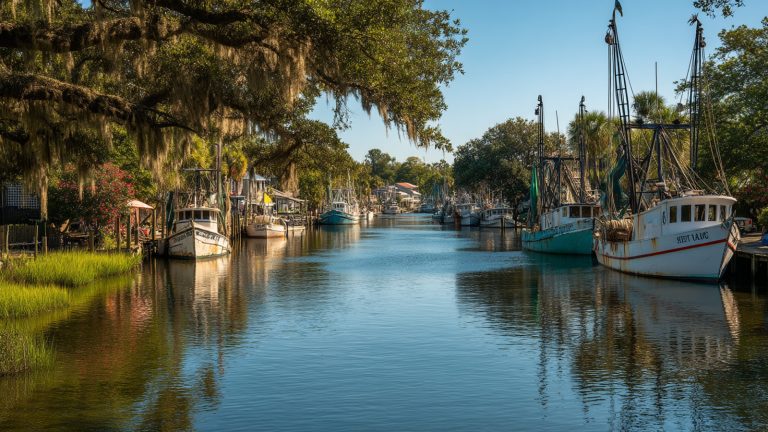
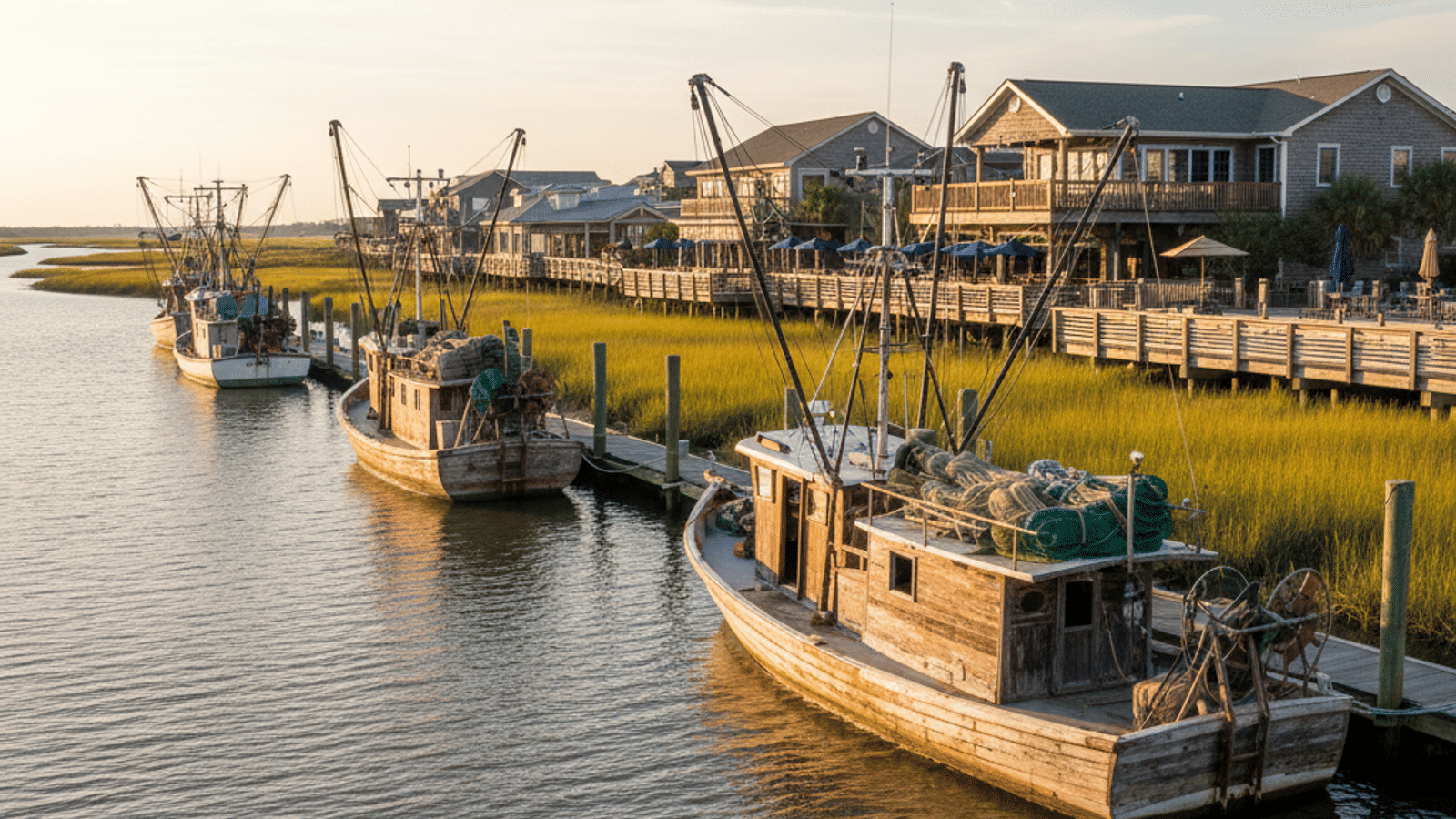
Shem Creek is the postcard image of Mount Pleasant, but it wasn’t always the leisure destination where we grab drinks and watch dolphins. In the 1700s, it was an industrial zone filled with shipbuilding operations and lime kilns. Later, it became a hub for milled rice and lumber transport.
The vibe shifted dramatically in the 1930s when Captain C. Magwood brought in the first ocean shrimp. That kicked off the “Shrimping Boom,” transforming the creek into the heartbeat of the local seafood economy. By the mid-20th century, restaurants started popping up to feed the locals and visitors, slowly turning the working waterfront into a social hub.
Today, Shem Creek balances these two identities perfectly. You can sit on a dock at a restaurant and watch active shrimp trawlers unloading their catch right next to kayakers and paddleboarders. If you are looking for waterfront homes Mount Pleasant SC, being near this mix of industry and recreation is often a huge draw.
Bridging the Gap: Connection to Charleston and Expansion
For centuries, if you wanted to get from Mount Pleasant to downtown Charleston, you took a ferry. That romantic but slow mode of travel defined the town’s pace until the 20th century.
- Grace Memorial Bridge (1929): This was the first vehicle bridge. It was narrow, steep, and frankly a bit scary to drive, but it finally opened the door for commuters.
- Silas Pearman Bridge (1966): As traffic grew, this second bridge was added to handle the load.
- Arthur Ravenel Jr. Bridge (2005): This is the game-changer. When this modern cable-stayed bridge opened in July 2005, it replaced the two aging bridges and solved a massive bottleneck.
The Ravenel Bridge didn’t just improve the commute; it sparked a real estate explosion. Suddenly, Mount Pleasant wasn’t just a quiet getaway; it was fully accessible, turning it into a primary residential hub for the entire metro area.
Hurricane Hugo and the Modern Boom (1989–Present)
If you ask locals about the defining moments of Mount Pleasant, they will almost always mention Hurricane Hugo. In September 1989, this Category 4 storm slammed into the coast, causing massive destruction. It destroyed the old town hall, severely damaged the Ben Sawyer Bridge, and left scars that took years to heal.
However, the recovery phase actually accelerated the town’s modernization. As the town rebuilt, infrastructure was updated, paving the way for the suburban explosion of the 1990s and 2000s. This era gave rise to the massive master-planned communities like Dunes West, Park West, and Carolina Park that many buyers look for today.
As of 2026, Mount Pleasant is the fourth-largest municipality in South Carolina. We have successfully transitioned from a storm-battered town to a highly desirable location that balances heritage with high demand for new construction Mount Pleasant SC.
Living History: Sites You Can Visit in 2026
One of the best things about living here is that history isn’t locked away in a book; it’s right in your backyard.
- Boone Hall Plantation & Gardens: Founded in 1681, this is one of America’s oldest working plantations. The Avenue of Oaks alone is worth the trip—it’s the scene you’ve likely seen in countless movies.
- Patriots Point Naval & Maritime Museum: You can’t miss the massive USS Yorktown (CV-10) sitting in the harbor. It’s a hands-on way to explore naval history.
- Mount Pleasant Memorial Waterfront Park: Located right under the Ravenel Bridge, this park offers great walking trails and historical markers regarding the sweetgrass basket makers.
- Charles Pinckney National Historic Site (Snee Farm): This site is dedicated to a drafter of the US Constitution and offers a quieter look at 18th-century plantation life.
Common Questions About Mount Pleasant History
When was Mount Pleasant, SC founded?
While the area was settled by the English as early as 1680, it didn’t officially become a town until 1837. That year, the villages of Mount Pleasant and Greenwich merged to form the incorporated town we know today.
Why is it called Mount Pleasant?
The name isn’t just a description of the vibe; it comes from a specific piece of land. It was named after the “Mount Pleasant Plantation,” which was owned by Jacob Motte in the mid-18th century.
What is the oldest neighborhood in Mount Pleasant?
The Old Village is the oldest and most historic neighborhood in town. It contains the town’s earliest homes and landmarks, serving as the original heart of the community before the modern suburban expansion.
How did the Arthur Ravenel Jr. Bridge change Mount Pleasant?
Opening in 2005, the bridge replaced two obsolete, narrow bridges, vastly improving access to downtown Charleston. This accessibility caused the population to skyrocket, transforming the town from a quiet suburb into a major residential and commercial hub.
Where can I see Gullah culture in Mount Pleasant?
You can experience Gullah culture firsthand along Highway 17 North, often called the Sweetgrass Basket Makers Highway. Here, local artisans display and sell handmade sweetgrass baskets, a tradition passed down from enslaved West African ancestors.